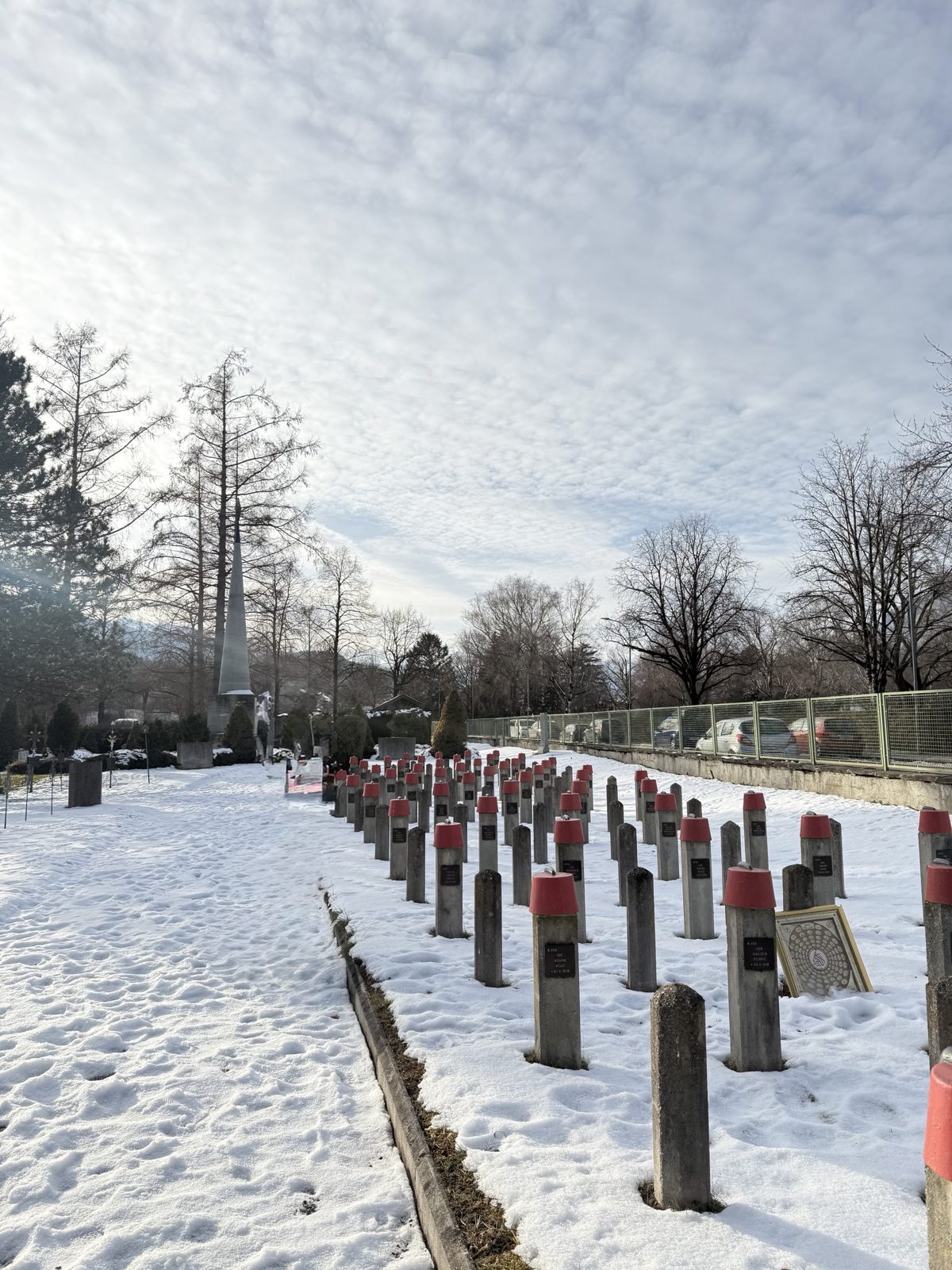
In a corner of the war cemetery in Innsbruck’s Amras district, rows of stone posts topped with red fezzes rise from the snow. Many visitors take them for the graves of Ottoman soldiers. The truth is a little different, but the story still leads back to the Ottomans.
Tyrol’s largest war cemetery
Amras War Cemetery (Soldatenfriedhof Amras) was laid out during the First World War, in 1917, and enlarged after 1945. It is the largest war cemetery in Tyrol, and more than 5,600 soldiers of many nations are buried here. The graves are grouped by origin: Tyrolean, Italian, Soviet and Muslim soldiers each lie in their own section.
Whose graves are these?
The Muslim section in the north-west of the cemetery holds soldiers of the Bosnian-Herzegovinian regiments of the Austro-Hungarian army. The posts face east, towards Mecca, and each is crowned with a red fez. Small plaques give the grave number, rank, name and date of death. Two neighbouring stones read:
- A 205 · Jgr · Salich Pomić · † 25.6.1918
- A 206 · Inf · Adam Agić · † 27.6.1918
“Inf” stands for infantryman and “Jgr” for Jäger (rifleman), both Habsburg army abbreviations. These are not a symbolic memorial but real graves, each belonging to one soldier.
Where is the Ottoman legacy?
Bosnia was under Ottoman rule for more than four centuries, from 1463 to 1878. In that time a large part of its population became Muslim, and mosques, bazaars and bridges were built (see Sarajevo and Mostar). In 1878 the region came under Austro-Hungarian administration and in 1908 it was formally annexed. Bosnian Muslims therefore served in the Habsburg army, and their uniform included the fez, a custom inherited from Ottoman times. That is why the stones wear red fezzes.
The dates on the readable plaques fall at the end of June 1918, just after the Battle of the Piave (15–23 June 1918), Austria-Hungary’s last major offensive on the Italian front. These soldiers were probably wounded at the front and died in Innsbruck’s military hospitals, though we cannot be certain for every grave.
A visitor has left a framed panel with the ninety-nine names of God beside one of the graves. More than a century later, these soldiers are not forgotten.
What to see today
- The Muslim section: east-facing posts with red fezzes and name plaques.
- The rest of the cemetery: graves and memorials of soldiers of many nations, traces of both world wars in Tyrol.
- Schloss Ambras: the Renaissance castle in the same district. The collections founded by Archduke Ferdinand II are said to include weapons and objects from the wars against the Ottomans; check before your visit which of them are on display.
Tips for your visit
The cemetery is in the Amras district and easy to reach from the city centre by public transport. Half an hour is enough for the Muslim section; combined with Schloss Ambras it makes a fine half-day outing. This is a cemetery: keep quiet, do not step on the graves and be respectful when taking photos. Check current opening times before you go.
For the most famous Ottoman traces in Austria, see the Vienna page.